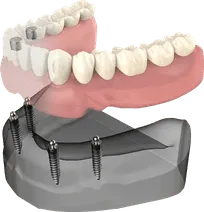


Getting dental implants is an exciting prospect. For many patients, these implants can mean the beginning of a new lease on oral health. They can experience confidence when speaking, biting, chewing, and smiling. Since dental implant systems are permanent, there is no need to worry about adhesives, cleaners, or other care products associated with traditional dentures.
All-On-Four dental implants offer another option for patients who need to replace an entire arch of teeth. Rather than placing an individual implant for every missing tooth, this approach uses four strategically positioned implants to support a full arch of replacement teeth.
At Oral & Facial Surgeons of Arizona, we want the experience of getting implants to be as comfortable as possible. When it comes to choosing an implant treatment, there are a few important factors to keep in mind.
What Are All-On-Four Dental Implants?
All-On-Four is a dental implant treatment designed to replace a complete upper or lower arch of teeth. Four dental implants are strategically positioned in the jaw to provide support for a full-arch restoration.
The placement of the implants is carefully planned according to the patient’s individual anatomy and available bone. The two implants toward the back may be placed at an angle, helping make use of available bone and providing support for the replacement teeth.
Unlike traditional dentures, which are removable, an All-On-Four restoration is supported by dental implants. This can provide greater stability when eating, speaking, and performing everyday activities.
How Are All-On-Four Implants Different From Traditional Dentures?
Traditional dentures are removable appliances designed to replace missing teeth. Complete dentures can replace all the teeth in an arch, while partial dentures replace several missing teeth when some natural teeth remain.
Because traditional dentures rest on the gums, some patients may experience movement while eating or speaking. Denture adhesives may also be used to help with stability.
All-On-Four dental implants are different because the restoration is supported by implants placed into the jaw. The implants provide a stable foundation rather than relying entirely on the gums for support.
This difference can make everyday activities more predictable for patients who have struggled with loose or uncomfortable dentures.
How Are All-On-Four Implants Different From Traditional Dental Implants?
Traditional dental implants can replace individual missing teeth or support bridges and other restorations. When many teeth are missing, several implants may be needed depending on the patient’s treatment plan.
All-On-Four uses four strategically positioned implants to support an entire arch of replacement teeth. This means patients do not necessarily need one implant for every missing tooth.
For some patients, the strategic placement of four implants can also help reduce the need for bone grafting. However, every patient’s bone structure is different, so an oral surgeon must evaluate the jaw before determining whether this approach is appropriate.
Patients researching all-on-4 dental implants phoenix can discuss their individual needs with an oral surgeon and learn how full-arch implant treatment may fit into their overall treatment plan.
What Are the Benefits of All-On-Four Treatment?
All-On-Four dental implants can provide several differences compared with traditional removable dentures.
Fixed Support
Because the restoration is supported by dental implants, patients do not need to remove it each day in the same way they would with traditional dentures.
Improved Stability
Implant-supported teeth are anchored to the implants. This can help reduce the movement that some patients experience with removable dentures.
Full-Arch Replacement
Four implants can support a complete upper or lower arch. This provides a full-arch solution without necessarily requiring an implant beneath every replacement tooth.
Support for Everyday Function
A stable restoration can help patients with everyday activities such as biting, chewing, and speaking. Individual results depend on oral health, treatment planning, and other factors.

Why Does Bone Matter for Dental Implants?
Jawbone health is an important part of dental implant treatment. When natural teeth are lost, the bone surrounding the missing tooth can gradually change because it no longer receives stimulation from the tooth root.
Dental implants act as artificial tooth roots and are placed into the jawbone. The surrounding bone can integrate with the implants, creating a foundation for the restoration.
One reason All-On-Four treatment may be considered for patients with bone loss is its strategic implant placement. By positioning the implants where adequate bone is available, the treatment may reduce the need for additional bone-grafting procedures in some cases.
However, this does not mean that every patient with bone loss will qualify for All-On-Four. Diagnostic imaging and a clinical examination are necessary before treatment recommendations can be made.
Who May Consider All-On-Four Dental Implants?
All-On-Four may be considered for patients who have lost most or all of their teeth in an upper or lower arch. It may also be an option for individuals whose remaining teeth are severely damaged and cannot be predictably restored.
Patients who currently wear traditional dentures and are looking for a fixed implant-supported option may also want to discuss All-On-Four with an oral surgeon.
Potential factors considered during an evaluation include:
- The condition of the remaining teeth
- Jawbone structure and available bone
- Gum and oral health
- Overall health
- Bite and functional needs
- The number of missing teeth
- The patient’s treatment goals
An oral surgeon can evaluate these factors and determine whether All-On-Four or another implant solution is more appropriate.
What Does All-On-Four Treatment Involve?
Treatment begins with an evaluation of your oral health and jawbone. Imaging and other diagnostic information can help the oral surgeon determine the position and condition of the available bone.
Once the treatment plan is established, the implants are placed in carefully selected positions in the jaw. The replacement teeth are then supported by the implants according to the patient’s individual treatment plan.
Treatment may also involve the removal of damaged teeth or additional procedures when necessary. The exact process and timeline vary from patient to patient.
Patients considering all-on-4 dental implants tempe can schedule a consultation to discuss their oral health, available treatment options, and whether this full-arch approach is appropriate for their needs.
Caring for All-On-Four Dental Implants
Although implant-supported replacement teeth cannot develop cavities in the same way as natural teeth, the tissues around the implants still require proper care.
Patients should follow their oral surgeon’s recommendations for cleaning and maintenance. Good daily oral hygiene and regular professional evaluations can help monitor the condition of the implants, restoration, gums, and surrounding tissues.
It is also important to report unusual discomfort, swelling, changes in the bite, or other concerns to your dental professional.
Choosing the Right Tooth-Replacement Option
All-On-Four dental implants offer a different approach to full-arch tooth replacement. Compared with removable dentures, they provide a fixed, implant-supported solution. Compared with traditional full-arch implant treatment, they use four strategically placed implants to support an entire arch of replacement teeth.
However, All-On-Four is not automatically the best choice for every patient. The right treatment depends on your oral health, bone structure, medical history, functional needs, and personal goals.
The oral surgeons at Oral & Facial Surgeons of Arizona provide individualized evaluations to help patients understand their options. A consultation can determine whether All-On-Four treatment or another tooth-replacement solution is appropriate for your needs.
If you are considering a full-arch solution, contact the location most convenient for you to schedule a consultation.
Phoenix Office
5050 N 40th St Suite 180
Phoenix, AZ 85018
Phone: (602) 899-8127
Tempe Office
1215 W Rio Salado Pkwy STE 113
Tempe, AZ 85281
Phone: (602) 900-9874
Frequently Asked Questions
1. How many implants are used for All-On-Four treatment?
All-On-Four treatment uses four strategically positioned dental implants to support a complete upper or lower arch of replacement teeth.
2. Are All-On-Four dental implants removable?
The implant-supported restoration is designed to remain fixed in place rather than being removed by the patient like traditional dentures.
3. Is bone grafting always required for All-On-Four?
No. Strategic implant placement may reduce the need for bone grafting in some patients, but an evaluation is necessary to determine the appropriate treatment.
4. Can All-On-Four replace an entire arch of teeth?
Yes. The treatment is designed to support a complete upper or lower arch using four dental implants.
5. How do I know if All-On-Four is right for me?
An oral surgeon can evaluate your oral health, jawbone, remaining teeth, medical history, and treatment goals to determine whether All-On-Four or another tooth-replacement option is appropriate.